
Golf in Highlands NC: Where Mountain Terrain Shaped a Century of Play
The mountains of Western North Carolina have drawn people toward something they could not quite name since the railroads first opened these peaks in the late 1800s. Golf in Highlands NC grew from that same pull, taking root in 1929 and quietly becoming one of the defining threads in mountain life across Highlands, Cashiers, and Sapphire Valley. What began as a summer luxury for lowland families has matured into a living tradition, shaped by terrain that refused to be tamed and communities that learned to love it that way.
This is not simply the story of courses and clubhouses. It is the story of how a sport became inseparable from the rhythm of mountain seasons, how designers learned to let the land lead, and how families found in these fairways something that felt less like recreation and more like belonging.
How Golf First Came to Highlands, North Carolina
Golf arrived in Highlands because people arrived in Highlands first. Founded in 1875 by developers who believed the area’s elevation and climate made it ideal for summer living, the town drew visitors from Charleston, Savannah, and Atlanta who came to breathe air that stayed cool even in August. They brought their leisure habits with them: tennis courts appeared at the inns, croquet lawns stretched beside the boarding houses, and as golf spread across America in the early 1900s, the summer residents brought that appetite to the mountains, too.
The challenge was the land itself. Unlike the coastal plains where many early American courses were carved from flat earth, the Highlands area offered steep hillsides, creek hollows, and old-growth forest. The terrain that made the region luminous also made it seem impossible for golf. Builders would have to find another way.
In 1929, Highlands Country Club opened as the area’s first golf course, establishing a tradition that would define mountain golf in Western North Carolina for generations. The founders did not fight the landscape. They followed it. The original nine holes climbed hillsides and dropped into valleys in ways that would have surprised any golfer who had only played flat ground. A 300-yard par 4 that climbed 50 feet of elevation played plenty long. A 150-yard par 3 that plunged downhill to a green ringed with trouble offered plenty of challenge. Distance mattered less than terrain, and the course showed that mountain golf did not need to imitate what had been done elsewhere. It needed only to be itself.
The club became a gathering place, a summer constant. Morning rounds gave way to lunch on the veranda. Afternoon games were settled more by pride than money. These were the first quiet rituals of a tradition that would only deepen with time.
Highlands Golf Courses and the Post-War Boom
Golf course development in the Highlands region accelerated through the 1960s and 1970s as designers and developers recognized that mountain golf was not a compromise but a category of its own. Better roads had made Western North Carolina more reachable, and the families who discovered these highlands found they were drawn back not just for the cool summers but for a different texture of life entirely.
Each new course faced the same essential question: how do you build golf that works with extreme topography while remaining playable for families and recreational golfers who simply want a good day outside? The answers varied. Some layouts followed creek valleys, using gentler ground to create more traditional rhythms. Others leaned into the mountain character, routing holes up and down slopes that would have been unthinkable to earlier builders. Earthmoving equipment had improved. Irrigation systems had matured. The craft was catching up to the ambition.
High Hampton Resort added golf to its offerings during this period, weaving a course around Hampton Lake and through rolling terrain that served families and guests without overwhelming them. The Highlands NC golf scene was quietly becoming a collection rather than a single destination, each course finding its own personality within the shared grammar of the mountains.
The Sapphire Valley Story: Golf in Highland NC’s Neighboring Valley
Just a few miles from Highlands, Sapphire Valley’s history traces back to 1973 when developer Darnall Boyd acquired 1,450 acres along the scenic Horsepasture River. Boyd had already rebuilt Lake Toxaway, restoring a community that the historic 1916 flood had silenced when the original dam gave way and drained the lake. His vision for what was then called Sapphire Lakes centered on a mountain community where golf and outdoor life worked together rather than competing for the same hours of the day.
Construction began with a pool house and dining area, then spread into the first residential properties. In 1983, work started on the golf course’s first nine holes. The back nine followed in 1985. This was a different model from what had come before. Rather than building the course first and selling lots around it, the community grew organically, and golf arrived when the residential roots were already in the ground. The result was a place where the golf course felt like a natural extension of the neighborhood rather than the reason for it.
In 2005, developer Mark Meadows purchased the property and began a new chapter of improvements. Members who purchased in 2009 completed the transition to member ownership by 2010, taking stewardship of land that had changed considerably since Boyd first walked the Horsepasture River banks more than three decades earlier. The community embraced the Burlingame name, drawn from Burlingame Creek nearby, and a new identity settled in alongside the old.
Tom Jackson’s Design: Mountain Golf at Burlingame

Tom Jackson’s design philosophy at Burlingame showed how far the craft of mountain course design had traveled since those early fairways were cut above Highlands in 1929. By the 1980s, designers had decades of accumulated knowledge about what the mountains would and would not allow, and Jackson used every lesson. Rather than routing holes wherever the land permitted, he created a course that used terrain strategically, making elevation changes not problems to solve but features that gave each hole its own character.
The routing moved through natural elements: the Horsepasture River, old-growth forests, rock outcroppings, and dramatic elevation changes between 3,000 and 3,500 feet. Some holes rewarded length. Others demanded accuracy. Some asked for precise iron play to a plateau green; others required patient course management across a hillside fairway. The greens were generous but subtly contoured, their breaks shaped as much by the slope of the land beyond the putting surface as by anything a shaper had added. Mountain golfers still talk about that quality, the way a Burlingame putt carries the memory of the ridge above it.
The result was golf that felt like it had always belonged in these mountains, not something built in spite of them.
Golf Course Architecture in Highlands NC: Lessons Learned Over Decades
The history of golf in Highlands NC cannot be separated from the evolution of golf course architecture itself. Early builders worked minimally because they had to. Modern designers often work minimally because they have learned that restraint is the correct answer in the mountains. The best courses route holes along natural corridors rather than blasting through ridges. They use existing rock outcroppings, creek beds, and mature trees as strategic features rather than clearing them away. They build fairways and greens that follow natural drainage rather than fighting it.
Elevation change receives careful consideration at every stage of design. A hole that climbs 50 feet from tee to green needs a generous landing area and a green that accepts shots arriving at a low trajectory. A downhill approach needs protection that keeps balls from running through the putting surface. Green sites in the mountains often occupy natural plateaus or benches, places where the land flattens just enough to hold a putting surface. Finding those spots and routing holes to reach them naturally is where a designer’s skill becomes visible. Forced carries, artificial mounding, and excessive earthmoving mark lesser mountain design. The finest courses look as if the land had always been waiting for golf to arrive.
Highlands NC Golf and the Community It Built
Golf in Highlands NC has always been as much about the people around it as the sport itself. The membership structure at clubs like Burlingame reflects this: families join together, multiple generations share rounds, and friendships form across the table at dinner after a day on the course. The smaller year-round population means members see the same faces across seasons, building connections that go well beyond golf.
Mountain club life follows its own rhythms. Summer brings tournaments and member-guest events, the social rounds and the gentle competition that feel like a family reunion where everybody genuinely likes each other. Fall offers quiet mornings and the hardwood forests turning gold and copper on every hillside. Winter sees a few devoted souls keeping their connection to the fairways through the still months. The wellness facilities, lawn sports, and shared dining expand what membership means. A family might spend a morning on the course, an afternoon at the pool, and an evening around the table together, all on the same piece of mountain land, all part of the same long day.
That is what the tradition of golf in Highlands has always carried inside it: not the sport alone, but the life that gathers around it.
Environmental Stewardship and the Future of Highlands NC Golf Courses
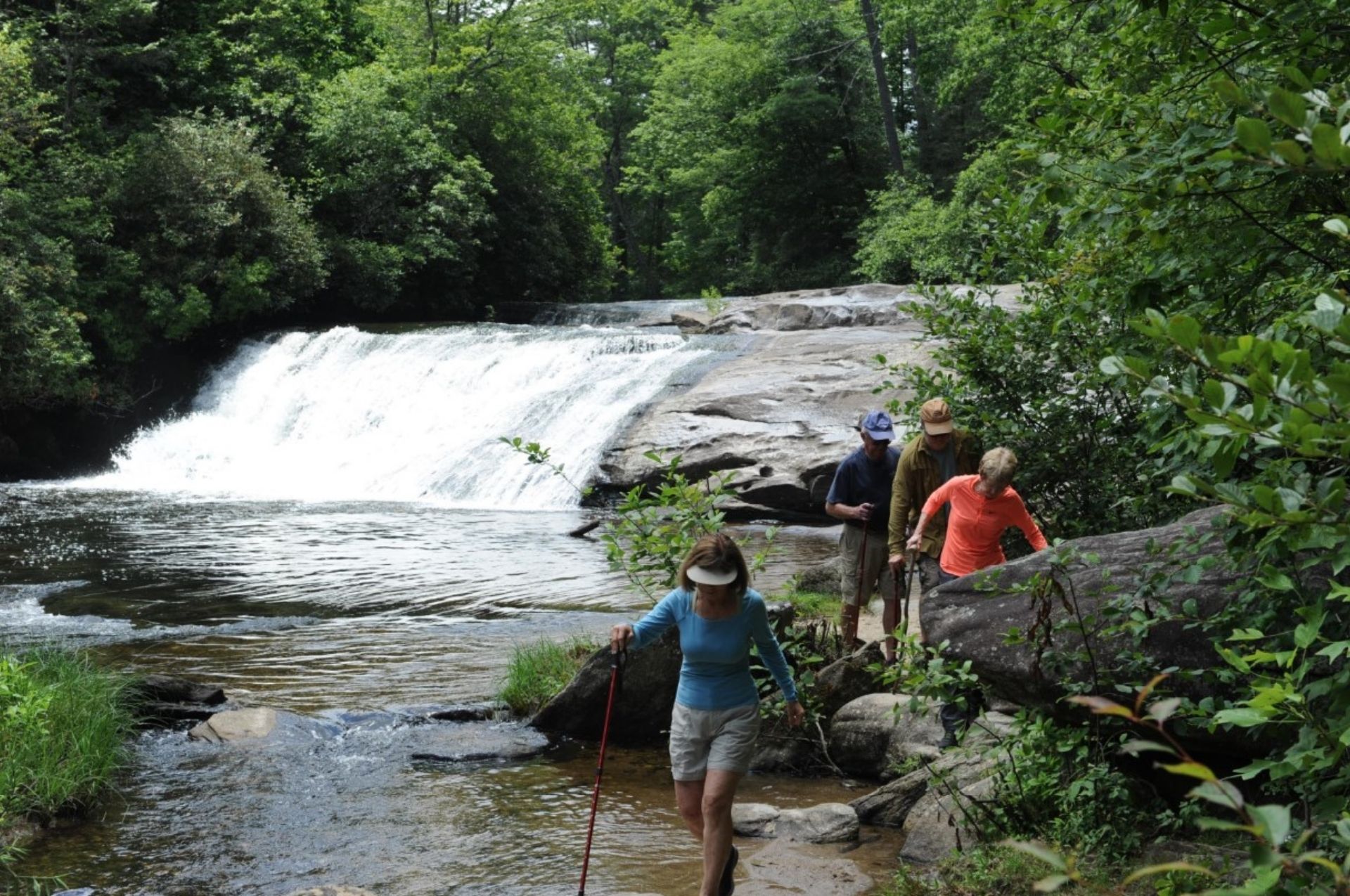
The environmental movement that gathered force in the 1960s and 1970s changed golf course design and maintenance across the country, but it landed with particular weight in the mountains. These watersheds feed rivers that communities depend on. The forests hold ecosystems that took centuries to form. Modern mountain courses like Burlingame balance golf with environmental responsibility: maintenance practices protect water quality, native areas are preserved rather than cleared, and wildlife corridors remain intact so the course stays part of the landscape rather than separate from it.
Golfers who choose the Highlands NC golf courses tend to value exactly this. They want to see white-tailed deer crossing a fairway at dawn. They want to know that the creek running beside the fourth hole is healthy. They appreciate turf management that keeps grass in playing condition without excessive chemical inputs. The golf course superintendent’s role has evolved from groundskeeper to environmental steward, responsible not just for the turf but for the creek banks, the forest edges, and the natural areas that give mountain courses their unmistakable character.
The future will likely see this stewardship deepen. Technology continues to change how the game is played, with GPS systems helping golfers account for elevation changes that can shift club selection by two or three numbers. Equipment makes mountain courses more accessible for all skill levels. But the land itself will remain the architect, and the golfers who come to these hills will keep finding what generations before them found: challenge and beauty joined together in a way that does not exist anywhere else.
Visiting Golf in Highlands NC: Where to Play

For those drawn to golf in Highlands and the surrounding valleys, several options invite exploration. Highlands Country Club continues operating much as it has since 1929, offering semi-private access during designated times so visitors can walk the region’s original mountain layout and feel the weight of nearly a century of play beneath their feet.
High Hampton offers a more accessible resort-focused experience, bringing classic mountain golf to guests without the structure of private membership. The combination of historic property and mountain setting creates rounds that stay with you.
Burlingame Country Club in nearby Sapphire Valley shows where the tradition has arrived today. Tom Jackson’s routing through the Horsepasture River valley represents the culmination of everything mountain golf has learned since Highlands Country Club first opened. Playing it is not just a round of golf. It is a way of understanding what the history of golf in Highlands has always been building toward: a place where the sport and the land and the people around you feel, finally, like they belong together.
Those interested in the public golf courses in Highlands NC and the broader mountain golf guide can find additional options across the region. And for those who feel something stir when they read about fairways carved from old-growth forest and greens built on natural plateaus above the Horsepasture River, there is a conversation worth having about what membership at Burlingame might mean for your family.
Frequently Asked Questions
When did golf first come to Highlands NC?
Highlands Country Club opened in 1929 as the region’s first golf course, establishing mountain golf in Western North Carolina nearly a century ago. The founders solved the challenge of extreme terrain by following the natural contours of the land rather than fighting them, routing holes up hillsides and down into valleys in ways that set the template for every mountain course that followed. That original nine-hole layout proved that golf in Highlands NC did not need to conform to the standards of flat-land courses. It needed only to work with what the mountains offered.
What makes Highlands NC golf courses different from other courses?
Golf courses in Highlands NC are shaped by terrain that commands respect. Elevation changes between 3,000 and 3,500 feet influence every shot. A hole that climbs 50 feet from tee to green plays very differently from a flat hole of identical yardage, and a downhill par 3 requires different green architecture than anything you would find on coastal ground. The best Highlands NC golf courses use rock outcroppings, creek valleys, old-growth forests, and natural plateaus as strategic features rather than obstacles to clear away. The result is golf that tests course management and imagination as much as distance.
Is there public golf in Highlands NC?
Yes. Highlands Country Club offers semi-private access during designated times, allowing non-members to experience the area’s original 1929 course. High Hampton Resort provides another option for visitors who want to play mountain golf in a resort setting without private club membership. Those researching public golf courses in Highlands NC can explore several options across the broader Highlands-Cashiers-Sapphire Valley region at different price points and levels of access.
Who designed the golf course at Burlingame Country Club?
Tom Jackson designed the championship course at Burlingame Country Club in Sapphire Valley, a few miles from Highlands. Construction on the first nine holes began in 1983, with the back nine completed in 1985. Jackson’s routing works through natural elements including the Horsepasture River, old-growth forests, and dramatic rock outcroppings at elevations between 3,000 and 3,500 feet. His philosophy of using terrain strategically rather than routing holes wherever space allowed represented the accumulated knowledge of decades of mountain course design and remains visible in every hole today.
Why did wealthy families originally come to Highlands NC?
Wealthy families from Charleston, Savannah, Atlanta, and across the lowland Southeast began coming to Highlands after the town was founded in 1875. The draw was the elevation and climate: mountain air that stayed comfortable through the peak of summer while coastal cities baked under heat and humidity. Golf followed those families to the mountains in the early 1900s as the sport grew in American popularity, and by 1929 the demand had grown large enough to support the region’s first course. The combination of summer relief, mountain scenery, and leisure community made Highlands a natural home for golf.
The story of golf in Highlands NC is still being written, one round at a time, one season folding into the next across fairways that have held these mountains for nearly a hundred years. If you feel ready to explore what membership at Burlingame might mean for your family, we would love to share more.
Please Contact Jennifer Webb — Membership Director for more information. Please use the form below or call 828.966.9200.