

If you’ve spent time at a traditional country club, you have a picture in your head of what private club membership looks like. A flat course, a formal dining room with a specific dress code, a calendar of events that runs through the social season, and a community built primarily around golf. Some of those clubs are excellent. The question worth asking before you compare Burlingame Country Club to them is whether you’re actually comparing the same thing.
You’re not.
Mountain club living at 3,000 feet in Western North Carolina operates differently from a traditional lowland club, and the differences go deeper than the setting. They affect what you do with your time, how the community forms, what your body feels like after a week there, and what it means to be a member. This is an honest comparison between the two, not a dismissal of one in favor of the other, but an attempt to be clear about which experience is actually better for a particular kind of person.
The Weather and What It Changes
A traditional lowland club in the Southeast operates in summer temperatures that limit outdoor activity to the early morning and late afternoon, with the middle of the day unsuitable for sustained exertion unless you’re comfortable with heat and humidity.
Burlingame sits at elevations between 3,000 and 3,500 feet. Summer temperatures here run 15 to 20 degrees cooler than the surrounding lowlands. The humidity is lower. The air is noticeably different in a way that people often comment on within an hour of arriving. You can play 18 holes in July at midday and not be destroyed by it.
This sounds like a practical advantage, and it is. But it’s also a philosophical one. The mountain climate doesn’t force you to schedule your life around avoiding the outdoors. You can use the property at any hour of the day and find conditions that make outdoor activity a pleasure rather than something to be survived.
For members who use a mountain retreat specifically to escape the lowland summer, this is the primary environmental advantage, and it’s not a small one.
The Course Itself
Golf on a flat course is a different game than golf in the mountains. Neither is inherently superior. They ask different things of you.
Tom Jackson’s 18-hole championship course at Burlingame uses terrain that no lowland architect has access to. The elevation changes, the river crossings, the views that open up on holes that crest ridgelines, and the way the mountain winds influence shot selection on certain holes create a course that demands a different kind of thinking than a flat layout does.
Playing well at Burlingame requires reading terrain. Managing altitude effects on ball flight. Understanding how mountain wind behaves differently from sea-level wind. Making decisions about elevation change on approach shots that don’t exist on a flat course.
This adds a layer of complexity and interest that some golfers love and others find frustrating. The honest answer is that you should play the course before making it central to your membership decision. Most people who do play it once come back because the combination of natural beauty and strategic challenge is genuinely compelling.
At elevations ranging from 3,000 to 3,500 feet, you also hit the ball farther. About 10 percent farther than at sea level. New members discover this on the first tee box and spend a few holes adjusting their expectations upward.
The Activity Range
A traditional private golf club offers golf, usually tennis, often a pool, and dining. These are the core amenities and most clubs do them well.
Burlingame offers all of those, but the mountain setting adds a category of activity that flat courses can’t replicate. Hiking trails that cover significant terrain and connect to hidden waterfalls. Fly fishing on the Horsepasture River, a legitimate trout fishery that flows through the property. A dog park. Croquet on a regulation USCA lawn. Mountain views available from most parts of the property on most days.
The range of activities at Burlingame means that non-golfing family members, or members who want to do something other than play golf on a given day, have real options rather than polite alternatives. A spouse who doesn’t golf can spend a full day at Burlingame and use the property well. Grandchildren have things to do that aren’t just sitting by the pool.
This matters in practice more than it might seem when you’re evaluating a membership. The question of whether the whole family can use and enjoy the property, rather than just the primary golfer, is one of the more practical membership considerations there is.
The Community Character
Traditional lowland clubs often have a formality to their community that reflects the history and demographics of private club culture. That formality has a real appeal for members who value tradition, dress codes, and clear social structure. The rituals of a formal club carry meaning.
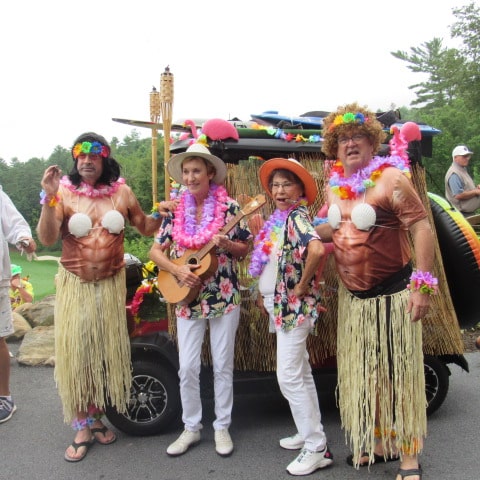
Burlingame’s community character is different. Members describe it consistently with words like warm, unpretentious, genuine, and welcoming. The dining is excellent but the atmosphere is not restrictive. The golf is championship quality but nobody is making you feel underdressed. The social events are well-attended because people actually want to go, not because the calendar demands it.
This isn’t the same as casual or lacking in quality. The food, the course conditions, the facilities, and the staff are all maintained at a level that reflects genuine investment in the member experience. The difference is that none of it comes with the social weight of formality. You’re welcome here because of who you are, not because of how you present.
For the member who wants excellence without pretension, this is a meaningful distinction.
The Mountain Retreat Dynamic
Many Burlingame members use the club as their primary mountain retreat, whether as seasonal residents, second-home owners near Lake Toxaway or in Cashiers, or frequent visitors who stay in the area for extended periods.
The mountain retreat context changes how you relate to a club. You’re not stopping by for a quick round on the way home from work. You’re here for the week, or the month, and the club is the center of your social life during that time. The density of activities available matters differently when you have extended time to use them.
Traditional lowland clubs often serve members who are fitting club activities into a regular working schedule. The round is scheduled around work, the dinner is an evening out. The club is one element in a week with many competing demands.
At Burlingame, when members are in residence, the club can be the organizing principle of the week rather than an element within it. That’s a different relationship with a private club, and it’s one that most members who experience it find they prefer.
The Honest Comparison
Traditional private golf clubs offer something real. The stability of a flat course you know in detail. The social traditions of a formal club. A community rooted in a particular local context.
Burlingame offers something different. A mountain environment that changes the physical experience of being outside. A course that demands more varied thinking. A community that formed around shared appreciation for a specific place rather than shared geography of a suburb or city. And a range of activities that keeps the entire family engaged.
The question of which is right for you depends on what you’re actually looking for. If you want a traditional club experience close to your primary residence and a course you’ll play three times a week year-round, Burlingame may not be it. The mountain location is a defining constraint as much as a defining advantage.
But if you want a mountain retreat built around an exceptional golf course, with a community that consistently surprises new members by how genuine it feels, with amenities that extend well beyond the 18th green, and with a natural setting that makes every activity feel like it’s happening in the right place, there isn’t a comparable option in Western North Carolina.
The members who call Burlingame “The Best of Times” aren’t being hyperbolic. They’re describing an experience that a different kind of club, however excellent, doesn’t produce.
To find out whether Burlingame is the right fit for your family,